


Navratri: A Journey Within – Awakening the Divine Forces Inside You
- ANAND BHUSHAN

- Apr 1, 2025
- 10 min read
🔷 यदि आप यह Article हिंदी में पढ़ना चाहते हैं, तो कृपया यहाँ क्लिक करें।
Each year, Navratri arrives — not just as a festival of rituals, but as a sacred window into your inner world. For most, it looks like temple visits, fasting, and prayers to goddesses. But what if we told you: Navratri is not about external worship at all?
It’s about meeting the real “you” — hidden behind layers of fear, ego, and forgetfulness. It’s about awakening 9 divine powers inside you, and letting go of what no longer serves your higher self.
Let’s understand what Navratri truly is.
What is Navratri, Really?
“Nav” means Nine
“Ratri” means Nights So, Navratri = Nine Nights of Inner Work
Night doesn’t just mean the time after sunset. It means going inward, where the mind becomes quiet, and the truth becomes visible.
These 9 nights are not a festival for entertainment —They are a sacred opportunity for self-correction, inner reflection, and spiritual rebirth.
Why Nine? What’s So Special About This Number?
Nine is the number of:
Completion: Just like it takes 9 months to form a new human life in the womb, these 9 nights help rebirth your true self.
Chakras : There are 9 inner energies or chakras (including subtle ones) that must awaken for full realization.
Cosmic transformation
In yogic and spiritual sciences, 9 phases represent the steps your inner energy (Shakti) takes to rise from the base of your spine to the crown of your awareness.
So Navratri is like a spiritual pregnancy — where your true self is reborn.
Who Are These 9 Devis?
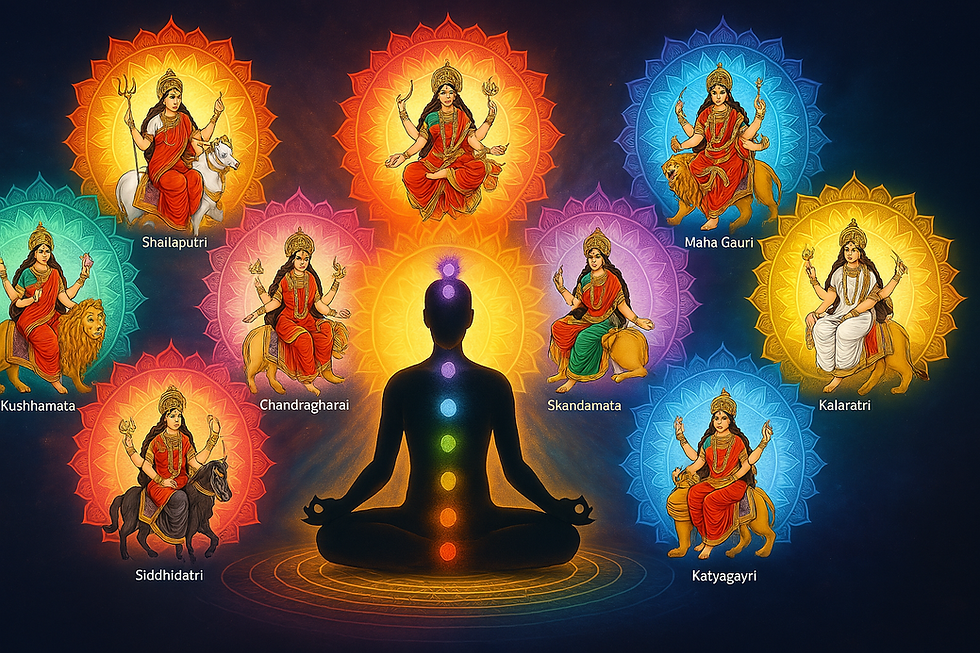
Inside every one of us, there are 9 deep-rooted ego traits — patterns that keep us trapped in fear, confusion, or imbalance. To cleanse each one, you don’t need anything from outside. You already have 9 powerful inner forces — one for each ego — waiting to be awakened.
These are the 9 Devis.
They are not goddesses sitting in the sky or outside of you. They are powers already within you —each one representing a quality, a force, or a deep inner strength that you must awaken, face, and embody.
And the only thing you truly need? Awareness and willingness to look within —Because the battle and the solution are both inside you.
Each day of Navratri is your opportunity to rise, reflect, and release — so that by the 10th day, you are no longer ruled by ego, but guided by your true Self.
The 9 Ego & Devis of Navratri – Awakening You, Cleansing the Ego
Day | Devi Name | What She Awakens in You | Ego Trait Cleansed |
1 | Shailputri | Grounding, stability, trust in life | Attachment |
2 | Brahmacharini | Self-discipline, focus, and willpower | Fear |
3 | Chandraghanta | Emotional balance, calm courage | Anger |
4 | Kushmanda | Creative fire, inner energy | Laziness (Tamas) |
5 | Skandamata | Nurturing your inner child, self-compassion | Pride |
6 | Katyayani | Fearless action, inner strength, valuing your own path | Jealousy |
7 | Kalaratri | Facing your shadows and destroying illusion | Illusion (Maya) |
8 | Mahagauri | Purity, forgiveness, and letting go | Guilt / Regret |
9 | Siddhidatri | Wholeness, intuition, and spiritual realization | Greed / Desire |
These are your inner tools. Navratri simply reminds you: you already have everything you need inside you.
Why Nine Is Sacred:
Ravana’s 10 heads represent egoic complexity — but only 9 of them are active. The 10th is symbolic of the false self — which vanishes when the other 9 are purified.
Navratri gives 9 nights to confront and dissolve these 9 inner demons.
The 9 Devis are your inner Shakti warriors — designed not to be worshipped, but embodied.
Nine is the final number before rebirth — the number of transcendence. After 9, you return to 1 (10 = 1+0).
So Navratri is the battle between 9 inner Ravanas and 9 inner Shaktis. And on the 10th day — your true Self emerges victorious.
What Most People Get Wrong About Navratri
Correcting two common modern-day misconceptions
In today’s world, especially among the educated and modern generation, there are two common ways people misunderstand Navratri:
1. “It’s an Old Ritual — Not Relevant Today”
Many educated people see Navratri as:
A religious festival from the past
A cultural event meant for the older generation
Something disconnected from modern science or logic
But here’s the truth: Navratri is not about blind faith. It’s about deep self-work, energy alignment, and emotional healing — things even modern science is now exploring.
The nine days are like a spiritual detox —cleansing your body, mind, and heart.
It’s not outdated. It’s timeless.
2. “It’s About Worshipping 9 Goddesses and Asking for Blessings”
This is the other extreme.
Many people — even the deeply religious — follow Navratri with full rituals, but:
Without knowing why they’re doing it
Treating Devi like a wish-granting entity
Asking for money, marriage, job security, etc.
Following customs just because their parents did
They believe there are nine human-like goddesses, sitting somewhere in the heavens, waiting to fulfill desires if pleased.
This is not wrong — but it is limited.
The real Navratri is not about asking. It’s about awakening.
It’s not about pleasing Devi, It’s about becoming Devi.
The Real Purpose of Navratri: Inner Transformation
Whether you are religious or scientific, spiritual or skeptical —Navratri has something for everyone because it is about you.
It teaches discipline without dogma
It shows energy awareness without superstition
It helps you meet your emotions, correct your patterns, and rise in consciousness
You don’t need to believe in “goddesses in the sky” to celebrate Navratri. You just need to believe that you are more than your fears and habits.
That’s all it asks of you.
Here’s how you can shift from old patterns to conscious celebration:
🧭 Navratri: Right View vs. Wrong View
Wrong View | Right View |
It's an old, outdated tradition with no relevance today | It's a timeless inner process for self-awareness, growth, and energy purification |
Worshipping 9 goddesses as real human-like beings sitting somewhere outside | 9 Devis represent 9 symbolic forces or qualities already within us |
Asking for wealth, marriage, or material gains during puja or fasting | Using the 9 days for spiritual reflection, ego cleansing, and inner awakening |
Performing rituals blindly, without knowing the purpose | Following rituals consciously as tools for personal transformation |
Fasting only for weight loss or health reasons | Fasting to calm the mind, clear emotions, and rise in awareness |
Seeing Navratri as a social, religious, or cultural compulsion | Experiencing Navratri as a personal, inward journey toward your true Self |
Worshipping Devi to get something | Awakening Devi within to become something greater |
What About Fasting Just for Health or Weight Loss?
In recent times, many people — especially in urban or fitness-aware circles — observe Navratri fasting purely for its physical benefits:
Detoxing the body
Giving the digestive system a break
Losing weight
Feeling light or disciplined
This isn’t wrong at all — in fact, it’s good that people are at least engaging with ancient practices, even for health.
But here’s the truth:
Fasting is not just about the body. It is about resetting the mind and re-centering the soul.
When you fast during Navratri with awareness, you're doing much more than skipping grains or avoiding salt:
You are burning karmic residues
You are calming emotional turbulence
You are refining your desires and attachments
So if you’re fasting just to lose weight — that's a start. But don’t stop there.
Let the body become light. But let the ego become lighter too.
The Real Battle – It’s Inside You
Navratri myths often mention Durga’s battle with Mahishasura or Rama’s victory over Ravana. But none of them are literal.
They are symbolic:
Mahishasura represents your inner demons — ego, doubt, laziness, confusion.
Ravana symbolizes your ten-headed ego — pride, anger, greed, attachment, etc.
Durga is your inner courage.
Rama is your inner light, your true Self.
The gods and demons in these stories are not real people —They are forces within you that rise and fall based on how aware you are.
Why Two Navratris in a Year?
We celebrate Navratri twice:
Chaitra Navratri (Spring): Time for renewal, inner rise, and new beginnings
Sharad Navratri (Autumn): Time for letting go, cleansing, and shedding old layers
Both are part of the natural spiritual rhythm — like inhaling and exhaling.
One uplifts your energy, the other clears your inner blocks. Together, they keep your soul awake and aligned.
Chaitra vs. Sharad Navratri – Two Seasons, One Soul
Aspect | Chaitra Navratri | Sharad Navratri |
Timing | Spring (March–April) | Autumn (September–October) |
Deity Focus | Subtle Shakti, Rama, Saraswati | Fierce Shakti, Durga, Kali |
Energy Quality | Awakening, planting, internal sadhana | Purging, celebrating, external radiance |
Celebration Style | Quiet, yogic, reflective | Public, festive, expressive |
Together, they form a cosmic inhale and exhale —Chaitra for spiritual rising, Sharad for karmic burning.
Who Created Navratri?
1. Not a Human, But a Cosmic Design
Navratri is not like a modern invention that can be traced to one person or group. It emerged from the timeless wisdom of Sanatana Dharma — the eternal way.
It was not "created" in a particular year by someone, but revealed by ancient Rishis, Tantrics, and Yogis who:
Understood the cycles of nature
Observed the energetic patterns of the sun, moon, body, and mind
Recognized the ninefold journey the soul takes to evolve and awaken
They didn’t create it for religion or it is for the entire human across all type and geographies. They offered it as a map — a sacred calendar of inner work.
2. Rooted in Shakta, Yogic, and Tantric Traditions
Navratri is deeply connected to Shakti Sadhana — the worship of the divine feminine energy, not as an external goddess, but as the force of life within us.
The structure of 9 nights + 10th victory day is found in:
Devi Mahatmya (from the Markandeya Purana)
Durga Saptashati
Tantric scriptures related to Navakshari mantra, Sri Vidya, and Kundalini
These weren’t religious instructions — they were tools of transformation.
Why Was Navratri Created (or Revealed)?
To help the human being move from ego to essence, from confusion to clarity, from restlessness to realization.
It was created as:
A spiritual container — 9 days of focus and inner cleansing
A symbolic framework — each Devi representing a layer to purify or awaken
A seasonal alignment — happening at two key cosmic transitions: spring and autumn
A soul training cycle — to rise above fear, ignorance, and limitation
Navratri exists because the human being forgets —and these 9 days are an invitation to remember who we really are.
Navratri was not created by humans to worship deities. It was revealed by Rishis so that we may worship the divine potential within us.
It is a gift from consciousness to consciousness, so that through symbolic ritual, inner reflection, fasting, silence, and surrender —we may return to Shiva, to Shakti, to Self.
Navratri: A Path Back to Dharma and Pure Consciousness
Navratri is not just a cultural celebration or a spiritual exercise. It is a sacred invitation for every human to:
Realign with Dharma (the natural, cosmic order)
Rise above illusion (Maya)
And realize their original nature — Pure Consciousness
Why?
Because in the journey of life:
We get lost in our roles, desires, fears, and attachments
Our mind becomes clouded, our energy scattered, and our decisions misaligned
Navratri comes as a course-correction cycle. Every six months — in spring and autumn — nature invites us to pause, reflect, purify, and realign.
The 9 Nights – Aligning Human Life to Universal Rhythm
Each of the 9 Devi forces is a layer of human evolution —and also a gate to deeper alignment with the universal laws.
Phase | What Devi Awakens | How It Aligns Us with Dharma |
Days 1–3 | Discipline, Strength | Grounding, facing ego, building inner resilience |
Days 4–6 | Creativity, Protection | Acting with clarity, purpose, and higher intention |
Days 7–9 | Wisdom, Purity, Liberation | Letting go of attachments, ego patterns, and becoming light |
The process is not to “please a goddess” but to become so aligned with truth that the divine reflects through you.
Ultimate Realization:
When the 9 nights of ego-cleansing are over, and the 10th morning rises, you don’t just “celebrate victory” —You become victory —Victory of the Self over the not-Self. Victory of Dharma over distortion. Victory of Consciousness over conditioning.
Navratri is a journey back to the Source.
It’s how a human:
Remembers their nature
Realigns with Dharma (an universal law)
And realizes: I was never separate from pure consciousness. I am That.
What Happens on the 10th Day (Vijaya Dashami)?
This is called the Day of Victory — but it’s not about a warrior winning outside.
It’s about you winning inside.
On this day:
The ego is silenced
The truth becomes clear
The seeker merges with the Self
You realize: You are not just a personality. You are awareness itself — calm, strong, and free.
How to Celebrate Navratri the Real Way
You don’t need rituals, pujas, or mantras in Sanskrit. You just need to show up for your own inner work.
Simple ways:
Sit in silence for 9 minutes every night
Journal one negative emotion you want to release each day
Reflect on the Devi quality you want to awaken that day
Speak less, eat light, walk in nature, and rest more
Practice forgiveness — of others and yourself
Who is Navratri Really For? A Journey from the Seeker to Everyone
At its root, Navratri was not created as a festival of outer celebration. It was revealed by ancient Rishis and sages as a spiritual process for those walking the inner path — the seekers, the meditators, the sadhakas.
These early practitioners used Navratri as a sacred time cycle to:
Reflect on their life and purify the ego
Awaken the inner Devi in all her forms
Align with Dharma and cosmic rhythm
Move closer to Self-realization and pure consciousness
For them, Navratri was not a performance — it was a personal fire of transformation.
And Then… It Became a Gift for All
As time passed, the wisdom of the Rishis was shared with the wider world. Because the truth is — everyone suffers, everyone carries inner battles, and everyone seeks peace.
So what began as an inward ritual for the few, became a healing path for the many.
Today, Navratri is for:
The busy soul longing for stillness
The confused mind searching for clarity
The devotee who prays with faith
The modern human seeking truth in a noisy world
And anyone who wants to become a better, freer, more conscious version of themselves
In Simple Words: Navratri is for You
Whether you:
Sit in silence
Follow rituals
Fast for health
Or just feel a call toward something deeper…
If you are ready to reflect, correct, release, and rise —Navratri is for you.
Because the Devi you seek is not outside. She is waiting within you, for you to come home.
Final Realization: You Are Not Separate from Devi — You Are Her
She dances in your breath, waits behind your silence, and rises when you finally pause.
After nine nights of turning inward, Nine steps of purifying the ego, Nine awakenings of the dormant divine within you...
You come face to face with a simple, eternal truth:
The Devi you worship is not outside of you. She is the strength in your spine, the clarity in your mind, the compassion in your heart, and the light in your soul.
She was never a goddess in the clouds. She was always the force within you, waiting to be seen, heard, and embodied.
By the tenth day — Vijaya Dashami —It is not a demon outside that is defeated. It is your own ego, your own illusion, your own forgetfulness that burns.
And what rises from the ashes is not a new personality —but your true Self — fearless, free, and full of light.
That is the real victory. That is the real Navratri. That is the real You.
This Navratri, don’t just perform rituals. Sit with yourself. Listen. The Devi is already speaking —Within you.


Comments