


The Eternal Epics – Rediscovering the Inner Truth of Ramayana, Mahabharata & Bhagavad Gita
- ANAND BHUSHAN

- Jul 16, 2025
- 5 min read
Updated: Aug 14, 2025
A Journey from Illusion to Dharma through the Universal Truth Visualization Model - My Point of View
-- By Anand Bhushan
“The sages never wrote for blind worship.They wrote for inner awakening.”
Why I Wrote This
After years of living, struggling, contemplating, and questioning the nature of reality — I came to a powerful realization:
The truth of the universe is not chaotic — it is patterned. Layered. Lawful.
This realization led me to develop a simple yet profound framework that captures the journey of existence — from the infinite source to our everyday human struggles. I call this the Universal Truth Visualization Model.
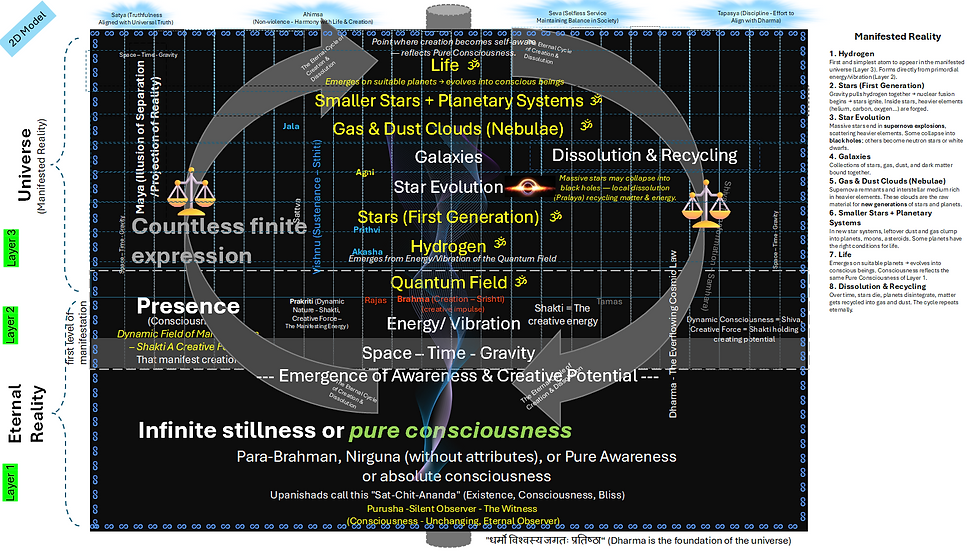
To know more about the explanation of the model click here.
It emerged from:
My deep immersion in Vedantic wisdom
Reading and re-reading ancient scriptures
Observing how life, energy, and awareness play out in reality
And understanding how our modern confusion is rooted in forgetting eternal truths
As I studied deeper, I realized something breathtaking:
The Ramayana, Mahabharata, and Bhagavad Gita — our most celebrated epics — were not historical records or religious books.They were spiritual operating systems… embedded with symbols, energies, and stories designed to teach every human being how to live aligned with Dharma.
And they map perfectly to the model I had visualized — revealing the layers of reality as experienced by the soul in human form.
Let me walk you through it.
The Universal Truth Visualization Model
Layer | Realm | Description |
Layer 1 | Infinite Stillness / Pure Consciousness | The unchanging source — God, Sat-Chit-Ananda, Para-Brahman |
Layer 2 | Creative Vibration / Presence | The field of Shakti, karma, dharma, guna, time, energy |
Layer 3 | Manifested Reality / Maya | The illusion of separation — ego, role, identity, fear |
Every experience you have — every emotion, decision, or awakening — moves through these three layers.The goal of life is not to escape these layers — but to remember your Self through them.
And that’s exactly what our ancient epics were trying to help us do.
RAMAYANA – The Journey from Ego to Dharma
“Ramayana is not the story of Ram. It is the story of the human soul becoming divine.”
To read the detailed version of Ramayana what it really meant click here
Symbolic Characters & Their Deeper Meaning
Element | Symbolism |
Rama | The awakened Self — calm, courageous, aligned with Dharma |
Sita | Shakti / Pure Consciousness — abducted by egoic desire |
Ravana | The ego-mind — brilliant but driven by pride and control |
Lakshman | Inner awareness — protective and alert |
Hanuman | Devotion and disciplined prana — the awakened energy serving the Self |
Lanka | The illusionary world built by desires and material pride |
Bridge to Lanka | Inner effort (sadhana) to reconnect the Self with Consciousness |
Alignment to the Model:
Sita’s abduction = descent into Layer 3 (illusion)
Hanuman’s leap = movement through Layer 2 (devotion, prana, discipline)
Rama-Sita reunion = return to Layer 1 (truthful awareness + Shakti)
Core Teachings:
Dharma must be upheld even in loss
Ego may appear powerful, but it always collapses
Devotion, discipline, and selflessness reconnect us with truth
Consciousness and energy must reunite for harmony to return
Modern Misunderstanding:
People worship Rama as a deity, but forget he symbolizes the ideal inner self — always guided by truth, even when it hurts.
MAHABHARATA – The Battle Within
“It’s not a war between cousins. It’s the war inside every human being.”
To read the detailed version of Mahabharata what it really means click here
Symbolic Characters & Their Deeper Meaning
Character | Symbolism |
Arjuna | The seeker — noble, confused, trapped in identity |
Krishna | The voice of inner awareness (Layer 1) — your still wisdom |
Pandavas | Higher self, dharmic tendencies, inner virtues |
Kauravas | Lower self — greed, jealousy, fear, desire |
Bhishma | Attachment to outdated ideals |
Karna | Inner conflict between loyalty and truth |
Kurukshetra | The battlefield of mind and life |
Alignment to the Model:
Arjuna’s grief = Layer 3 (ego entangled in duty/emotion)
Krishna’s teaching = Layer 1 voice through Layer 2 (karma/dharma/guna)
War = symbolic of the inner evolution through conflict and clarity
Core Teachings:
Even wise people can fall when driven by ego
Life will often present no perfect choice — only Dharma-aware action
You must act — but let go of outcome
The war is not to win — it is to awaken
Modern Misunderstanding:
People see it as a family feud or epic drama. But it’s about your daily struggle — between greed and generosity, emotion and duty, noise and clarity.
BHAGAVAD GITA – The Voice of Stillness in Chaos
“You have the right to action, not to the fruits thereof.”
To read the detailed version of Mahabharata what it really means click here
Core Teachings & Their Spiritual Layers
Teaching | Message | Model Mapping |
Karma Yoga | Do your duty without attachment | Layer 2 (Energy in Dharma) |
Jnana Yoga | Know your Self is eternal | Layer 1 (Pure Awareness) |
Bhakti Yoga | Surrender to the Supreme within | Bridge from Layer 3 → 1 |
Gunas | Transcend the forces that bind the mind | Layer 2 dynamics |
Sthitaprajna | Stay unmoved amidst gain/loss | Embodied Layer 1 consciousness |
Alignment to the Model:
Arjuna’s paralysis = Layer 3 confusion
Krishna’s wisdom = Layer 1 truth
Gita’s framework = Full-spectrum guidance for Layer integration
Core Teachings:
You are not the body or mind — you are awareness itself
Suffering comes from misidentification and desire
Dharma is not fixed — it is conscious alignment
Liberation lies in inner surrender, not outer escape
Modern Misunderstanding:
Gita is often treated as a religious sermon or fatalist advice — but it’s really a consciousness handbook for anyone living in the modern world.
Common Thread Across All Three
Theme | What They Teach |
Self-realization | You are not the ego or role — you are the witness |
Dharma | Align with truth, not trend |
Ego & Desire | Are the root of suffering, not external demons |
Worship & Surrender | Are internal realignments, not external rituals |
Suffering | Is the symptom of forgetting your real nature |
Time to Read the Inner Epics
We’ve turned these epics into worship manuals.But they were meant to be awakening tools.
The Ramayana plays out when you choose your higher nature over temptation
The Mahabharata happens every day — in your choices, emotions, and inner battles
The Gita speaks whenever you ask: “What is right? What is true? Who am I really?”
Read them not as stories of the past — but as maps of your inner world.That’s when their magic awakens.That’s when mythology becomes mechanism.That’s when you begin to walk as a child of Dharma — the kind the sages dreamed would rise again.
If this resonates with you:
Explore the Universal Truth Visualization Model for your own inner journey
Share this article with anyone seeking truth, clarity, or direction
Reach out to collaborate on a book, workshop, or visual guide for conscious living
Let’s revive not the religion — but the realization these epics were always pointing to.
Truth is eternal. Dharma is timeless. You are That.


Comments